


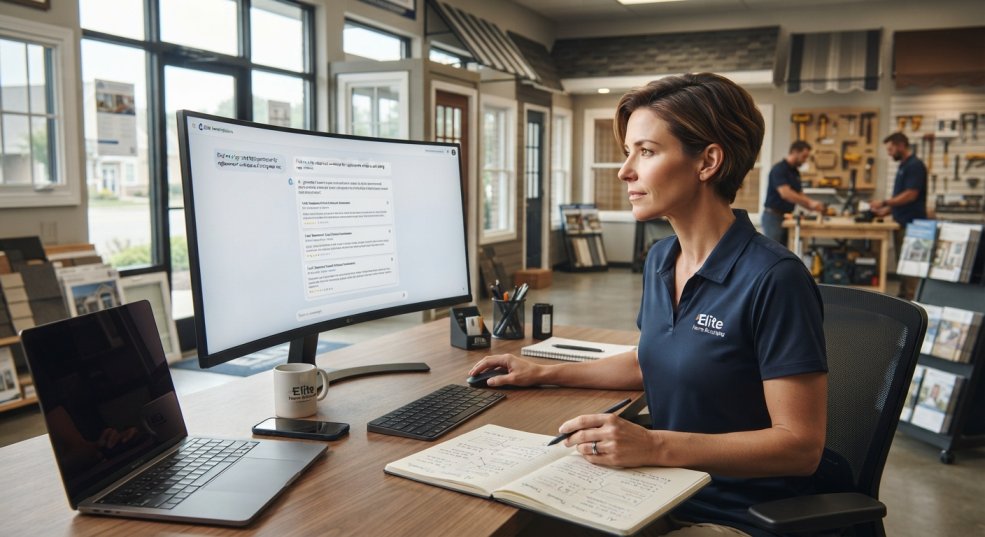

Home improvement SEO in 2026 is no longer about adding a few keywords to a website and waiting for Google to rank it. Homeowners use Google Search, Maps, reviews, and increasingly AI-powered search to compare companies before requesting an estimate. A strong strategy connects local SEO, useful content, technical performance, and trust signals so your business is visible wherever potential customers are looking.
What Is SEO for a Home Improvement Business?
SEO for a home improvement business means optimizing your website, online profiles, content, and reputation so homeowners can find your company when they search for the services you provide.
That can mean appearing when someone searches for “pergola builder near me,” “hurricane shutters in Miami,” “retractable screen installation,” or a more informational query such as “are hurricane shutters worth it?”
Unlike many industries, home improvement has a long buying journey. A homeowner may research products, compare materials, check photos, read Google reviews, investigate installation costs, and look at several companies before making contact. That makes SEO about more than traffic. It is about being visible throughout the decision-making process.
For high-ticket services, the goal should be qualified leads and revenue, not simply higher visitor numbers. Meridian Social takes this approach by focusing its SEO strategy on the search queries that can turn into actual opportunities for home improvement companies.
Start With Keyword Research and Search Intent
Before creating pages or publishing blog posts, understand what potential customers are actually searching for.
Effective keyword research should cover your services, products, locations, customer problems, pricing questions, comparisons, and installation needs. Don’t limit your strategy to broad phrases such as “home improvement.” Those searches are often too vague to reveal what the person actually wants.
Instead, build groups around different types of search intent.
Someone searching “what are retractable screens” has informational intent. A person searching “retractable screens vs traditional screens” is researching options. Someone searching “retractable screen installer near me” has strong transactional and local intent.
Long-tail keywords are particularly useful because they often reveal a specific need. A phrase such as “motorized patio screens for large openings” tells you considerably more about the customer’s situation than “patio screens.”
Your content should reflect these differences. Informational keywords belong naturally in educational guides and blog content, while transactional keywords are better suited to service and conversion pages.
Build a Strong Local SEO Foundation
For most home improvement businesses, Local SEO should be at the center of the strategy.
Homeowners generally want someone who can actually serve their property. That means your company needs strong geographic relevance across both your website and local search presence.
Optimize Your Google Business Profile
Your Google Business Profile is one of the most important assets for local visibility. Keep your business name, phone number, website, categories, services, hours, photos, and service information accurate and up to date.
Add relevant photos of completed projects, products, installations, teams, and other legitimate business activity. Your profile should reinforce what your website says about your company.
A well-optimized profile can also strengthen your visibility across Google Maps and help your business compete for the Map Pack, sometimes called the Local Pack.
Target the Map Pack
When a homeowner searches for a local service, Google may display a map and a small group of businesses above or alongside traditional organic results.
Your ability to appear there depends on several factors, including relevance, geographic proximity, prominence, reviews, and the overall consistency of your business information.
For a service-area business, this becomes especially important. If you serve several cities but don’t operate storefronts in every one, your website and local SEO strategy need to clearly communicate where you provide services without creating low-value pages for every possible location.
Create Dedicated Service and Location Pages
One of the biggest SEO mistakes home improvement companies make is trying to rank every service from a single page.
If you install pergolas, retractable screens, awnings, and hurricane shutters, each major service should have a dedicated service page.
A strong service page should explain what the service is, who it is for, available options, benefits, installation considerations, common questions, relevant projects, and what the customer should do next.
Your location pages should work similarly. Instead of swapping a city name into the same generic paragraph, create genuinely useful local resources. Discuss the services you provide in that area, local homeowner concerns, relevant projects, climate considerations, regulations where appropriate, and why your company serves that market.
This gives Google, and potential customers, real context about your business.
Strengthen On-Page SEO and Internal Linking
Good on-page SEO isn’t about repeating a keyword in every paragraph. It is about making the page’s topic unmistakably clear while providing useful information.
Use descriptive title tags, logical H1-H4 headings, relevant terminology, concise answers, descriptive URLs, helpful images, and natural language.
Then connect related pages through internal linking.
For example, an article about choosing a pergola could link to your pergola installation service page. That service page could link to relevant city pages and a project case study. A location page could link back to the specific services available there.
This creates a logical relationship between your content and helps visitors discover the information they need.
Don’t Ignore Technical SEO
Even excellent content can struggle when a website has technical problems.
A strong technical SEO foundation means making your website easy for search engines to crawl, understand, and index. Check for broken links, duplicate pages, indexing issues, poor URL structures, redirect problems, and other technical obstacles.
Website performance matters too. Pay attention to Core Web Vitals, image sizes, scripts, server performance, and page-loading times.
And make mobile optimization a priority. Homeowners frequently search from smartphones, so important actions such as calling, requesting an estimate, viewing project photos, or submitting a form should be effortless on a small screen.
For home improvement companies, the website should ultimately function as a sales tool, not simply an online brochure.
Use Schema Markup and Structured Data
Schema markup, also known as structured data, gives search engines additional information about the content on your pages.
For a local company, LocalBusiness schema can communicate information such as the business name, address, phone number, operating hours, and other relevant details. Google explains that LocalBusiness structured data can help it understand business information displayed in Search and Maps.
Depending on the content and eligibility, businesses can also consider relevant structured data for services, breadcrumbs, FAQs, and other appropriate page elements.
Schema isn’t a shortcut to rankings, and adding it doesn’t guarantee a rich result. Its value is in making your content and business information easier for search engines to interpret.
Build Authority With Reviews, Citations, and Local Backlinks
Trust is crucial when someone is considering spending thousands of dollars on a home improvement project.
Start with Google reviews. Develop a consistent review generation process that makes it easy for satisfied customers to leave honest feedback. Respond professionally to reviews and never manufacture or purchase them.
Next, maintain NAP consistency, your business Name, Address, and Phone number, across your website, Google Business Profile, directories, social profiles, and other important listings.
These listings are often referred to as local citations. Focus on accurate, relevant directories and industry sources rather than creating hundreds of low-quality listings.
You should also invest in link building and local backlinks. A mention from a respected local publication, industry organization, supplier, community organization, or relevant home improvement website can provide a much stronger signal than a collection of unrelated links.
The objective isn’t to collect links for their own sake. It is to build genuine authority around your business and its market.
Create Content Around the Homeowner’s Buying Journey
A good home improvement content strategy answers questions before the customer is ready to call.
At the awareness stage, homeowners may search for definitions, ideas, benefits, or problems. During consideration, they compare materials, products, designs, costs, and alternatives. Near the decision stage, they search for installers, local companies, estimates, and specific services.
Your content should cover all three stages.
Useful formats include buying guides, cost explanations, product comparisons, installation guides, FAQs, project case studies, before-and-after stories, and local service content.
This approach also gives your service pages more context. Instead of having a website filled with disconnected articles, you create a network of content that supports the customer from their first question through the estimate request.
Optimize for AI Search and AI Overviews
SEO in 2026 also means thinking beyond traditional blue-link rankings.
Google continues to develop AI-powered search experiences, including AI Overviews and AI Mode, while people increasingly use conversational systems to research businesses and products. Google itself now provides guidance specifically addressing visibility in generative AI features while emphasizing that established SEO fundamentals still matter.
This is where Answer Engine Optimization (AEO) and Generative Engine Optimization (GEO) become useful concepts.
AEO focuses on creating clear, direct answers that can work well for question-based searches, featured snippets, and answer engines. GEO focuses more broadly on making your content understandable, useful, authoritative, and worthy of being referenced in generative search experiences.
For a home improvement company, that means answering questions clearly rather than burying the answer beneath unnecessary filler.
For example, instead of writing 500 words before explaining how long a typical installation takes, give the direct answer first and then provide the supporting detail.
Google’s current guidance also emphasizes original, non-commodity information and useful local, image, and video content for generative search experiences.
That makes real project experience particularly valuable. Original photographs, installation details, project examples, expert explanations, specifications, comparisons, and locally relevant information can give your content substance that generic pages lack.
Avoid Common Home Improvement SEO Mistakes
Many businesses lose SEO opportunities by focusing on tactics instead of the customer.
Common problems include targeting only broad keywords, publishing thin location pages, creating one generic page for every service, ignoring Google Business Profile, neglecting reviews, allowing inconsistent business information, and overlooking mobile performance.
Another growing problem is publishing large amounts of generic AI-generated content without adding firsthand knowledge.
AI can accelerate production, but it shouldn’t replace expertise. The strongest content should demonstrate that the business actually understands its products, installation process, customers, market, and projects.
Measure SEO by Leads, Not Just Rankings
Rankings are useful, but they aren’t the final objective.
Track organic traffic, keyword visibility, Google Business Profile interactions, Maps activity, calls, form submissions, estimate requests, booked appointments, and ultimately revenue.
A page ranking at #1 for an irrelevant keyword isn’t necessarily valuable. A page ranking lower for a highly qualified local search can generate far more business.
The best SEO reporting connects search visibility with what happens after someone finds you.
2026 SEO Checklist for Home Improvement Businesses
A strong strategy should bring the major pieces together: keyword research, search intent, Google Business Profile optimization, Google Maps visibility, service pages, location pages, on-page SEO, technical SEO, Core Web Vitals, mobile optimization, schema markup, reviews, local citations, relevant backlinks, internal linking, useful content, and AI search optimization.
The goal isn’t to optimize each item in isolation. It’s to make all of them reinforce one another.
Final Thoughts
SEO for a home improvement business in 2026 is about becoming the most useful and trustworthy answer wherever homeowners search. That means strong local visibility, helpful service content, technical performance, genuine reviews, relevant authority, and preparation for AI-driven search. When these pieces work together, SEO becomes more than a traffic channel, it becomes a long-term system for generating qualified home improvement leads.