



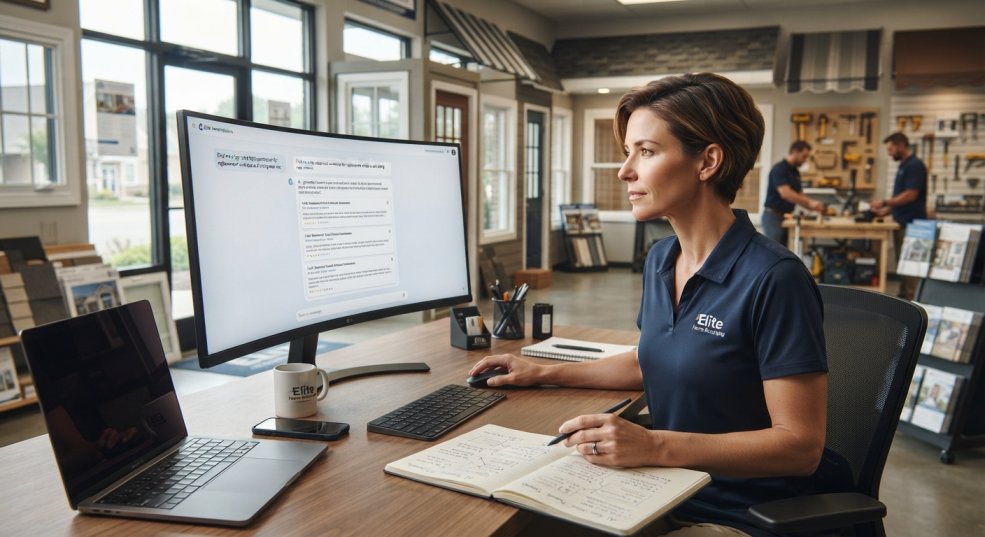
Getting found when homeowners search for a contractor in their area can make a major difference to your pipeline. A strong Local SEO strategy helps your business appear where high-intent customers are already looking, Google Search, Google Maps, and local directories. This Local SEO checklist for home improvement contractors covers the essential steps, from optimizing your Google Business Profile to building local authority and turning search visibility into qualified leads.
What Is Local SEO for Home Improvement Contractors?
Local SEO is the process of improving your online presence so homeowners can find your business when searching for services in a specific geographic area. Unlike traditional SEO, which can target a broad audience, local search focuses heavily on location, service, and customer intent.
For example, someone searching for “window replacement contractor near me” or “home remodeling company in Miami” isn’t simply researching the industry. They may be comparing contractors and preparing to request an estimate.
That makes local visibility particularly valuable for home improvement companies. The goal isn’t simply to generate website traffic. It’s to attract homeowners who are actively looking for the services you provide.
Local SEO Checklist for Home Improvement Contractors
1. Optimize Your Google Business Profile
Your Google Business Profile should be one of the first priorities in your local SEO strategy. This profile can help your business appear in Google Search and Google Maps when people search for relevant services.
Make sure your business name, phone number, website, hours, categories, and other information are accurate. Choose the most relevant primary category and add appropriate secondary categories when available.
Your profile should also clearly communicate your service area. Upload high-quality project photos, keep your information current, and regularly add useful updates when appropriate.
For contractors, visual proof can be especially powerful. Photos of completed remodeling projects, installations, exterior improvements, and other work can give potential customers a better understanding of what your company actually does.
2. Improve Your Google Maps Visibility
Google Maps is an important part of local discovery for home improvement businesses. Homeowners may use Maps to compare nearby contractors, check reviews, view photos, and visit a company’s website.
A complete Google Business Profile is the foundation, but your broader online presence matters too. Consistent business information, legitimate customer reviews, relevant website content, and strong local signals can all contribute to a more trustworthy presence.
Don’t try to manipulate your location or create listings for areas you don’t genuinely serve. Instead, build visibility around the communities where your business actually operates.
3. Maintain NAP Consistency
NAP consistency refers to keeping your business’s Name, Address, and Phone number accurate and consistent across the web.
Check your information on your website, Google Business Profile, directories, social profiles, industry websites, and other local listings. An old phone number or outdated business address can create confusion for both customers and search engines.
If your company has changed its name, moved locations, or updated its phone number, conduct a citation audit and correct outdated information.
4. Build and Manage Local Citations
A local citation is a mention of your business information on another website or directory. Relevant citations can reinforce your business identity and geographic relevance.
Start with trustworthy platforms and industry-relevant websites instead of trying to create hundreds of low-quality listings.
Depending on your market, this can include Yelp, Apple Maps, Bing Places, local chambers of commerce, trade associations, and reputable industry-specific directories.
The quality and relevance of your listings matter more than simply collecting as many citations as possible.
Conduct Local Keyword Research
5. Find the Search Terms Your Customers Actually Use
Effective local keyword research begins with understanding how homeowners describe both their problem and the service they need.
A contractor may provide “exterior shading solutions,” for example, while a homeowner searches for “retractable awnings near me.” Your research should account for these differences.
Look at combinations of services, locations, products, and customer needs. Search patterns might include:
- Service + city
- Service + neighborhood
- Product + location
- Contractor + city
- Service + “near me”
The goal is to identify meaningful searches that match your actual services rather than forcing awkward keywords into your content.
6. Optimize for “Near Me” Searches
Near me searches are closely tied to local intent. However, you don’t need to repeat “near me” throughout your website.
Instead, strengthen the signals that demonstrate where your business operates. Keep your Google Business Profile accurate, publish useful local content, clearly identify your service areas, and create genuinely helpful service and location pages.
Optimize Your Website for Local Search
7. Create Detailed Service Pages
Every major service should have its own useful service page when there is enough information to justify one.
A page for window installation, for example, should explain the service, materials or options, benefits, process, relevant FAQs, project examples, and areas served.
Avoid creating pages that simply swap one city name for another. Search engines and users benefit more from pages containing original, useful information.
8. Build Valuable Location Pages
Location pages can help contractors communicate where they genuinely provide services. A strong page should offer more than a city name inserted into a template.
Include relevant services, local project examples, customer experiences, frequently asked questions, and information about serving that particular community.
9. Create Local Landing Pages
A local landing page should align closely with a specific combination of service and location.
For example, a contractor serving several markets could create useful pages around its core services in the communities where it actually operates. Each page should have a clear purpose and provide value to someone considering hiring the company.
Strengthen On-Page and Technical SEO
10. Improve On-Page SEO
Your on-page SEO should make it immediately clear what each page is about and whom it serves.
Use descriptive title tags, logical headings, useful content, relevant internal links, descriptive image text, and compelling meta descriptions. Don’t write for search engines at the expense of homeowners. The page should answer their questions naturally.
11. Improve Internal Linking
Internal linking helps users and search engines discover related content. Connect relevant service pages with location pages, project examples, blog articles, and contact or estimate pages.
For example, a blog post about choosing replacement windows could naturally link to your window installation service page.
12. Address Technical SEO Issues
A strong content strategy won’t perform as well if your website has serious technical problems. Your technical SEO checklist should include crawlability, indexing, broken links, duplicate content, HTTPS, XML sitemaps, redirects, and canonical URLs.
Use Google Search Console to identify indexing problems and monitor how Google is discovering your pages.
13. Improve Website Speed and Mobile Optimization
Website speed and mobile optimization matter because many homeowners research contractors from smartphones.
Your website should load quickly, display properly on smaller screens, and make important actions easy to complete. Click-to-call buttons, simple contact forms, readable text, and straightforward navigation can reduce friction for potential customers.
Compress large images and remove unnecessary scripts or other elements that slow down important pages.
Use Local Business Schema and Structured Data
14. Add Local Business Schema
Local Business Schema is a form of Schema markup that can help search engines understand important information about your business.
Depending on your business and implementation, structured data can communicate details such as your business name, website, contact information, address, hours, and other relevant information.
Only include information that accurately represents your business and follows search-engine guidelines. Schema isn’t a shortcut to rankings, but it can make your website’s information easier for search engines to interpret.
Build Trust With Reviews and Project Content
15. Develop a Google Reviews Strategy
For home improvement companies, Google reviews can provide valuable social proof. A homeowner considering a major renovation or exterior project wants confidence that the contractor has successfully completed similar work.
Ask genuine customers for reviews after completed projects and make the process simple. Don’t manufacture reviews or pressure customers to leave misleading feedback.
16. Make Review Management Part of Your Process
Effective review management means monitoring new reviews and responding professionally. Thank customers for positive feedback and address legitimate concerns constructively.
A thoughtful response can demonstrate that your company takes customer experience seriously.
17. Showcase Project Photos
Your website and Google Business Profile should showcase real project photos whenever possible.
Use images that demonstrate the quality and range of your work. Include completed projects, installations, renovations, and other examples relevant to the services you’re promoting.
Before-and-after photos can be particularly useful because they demonstrate the transformation rather than simply describing it.
Build Local Authority With Backlinks
18. Earn Local Backlinks
Local backlinks can strengthen your website’s authority and geographic relevance when they come from credible, relevant sources.
Potential opportunities include local publications, community organizations, suppliers, trade associations, business partnerships, sponsorships, and industry websites.
The focus should be on relevance and credibility rather than acquiring a large number of links.
19. Use Ethical Link Building
A sustainable link building strategy should prioritize relationships and genuinely useful resources. Avoid tactics based on buying large quantities of poor-quality links or participating in manipulative link schemes.
For a home improvement business, creating useful project resources, collaborating with local organizations, and earning coverage for notable work can provide more meaningful opportunities.
Track Your Local SEO Performance
20. Monitor Google Search Console
Google Search Console provides useful information about your organic search performance. You can monitor queries, clicks, impressions, average positions, indexing issues, and individual page performance.
Use this data to identify opportunities. If a service page receives impressions for relevant searches but few clicks, for example, its title and description may need improvement.
21. Analyze Performance With Google Analytics
Google Analytics can help you understand what happens after people reach your website.
Look beyond traffic numbers. Pay attention to important actions such as phone clicks, form submissions, quote requests, engagement, and the pages that contribute to conversions.
The ultimate objective is not simply higher rankings. It’s turning relevant search visibility into high-intent local leads and measurable business opportunities.
Common Local SEO Mistakes Home Improvement Contractors Should Avoid
Some of the most common mistakes are surprisingly simple: an incomplete Google Business Profile, inconsistent NAP information, thin location pages, neglected reviews, slow mobile pages, duplicate content, and low-quality backlinks.
Another mistake is focusing entirely on rankings. A contractor can receive organic traffic without generating meaningful inquiries if the traffic doesn’t match the services, locations, or buying intent of its ideal customers.
Local SEO works best when your website, Google presence, reputation, content, and conversion experience all support the same business goals.
How Long Does Local SEO Take for Home Improvement Contractors?
There isn’t a universal timeline for Local SEO. Results can vary based on competition, location, website history, existing authority, review profile, content quality, technical issues, and the strength of competing businesses.
Instead of expecting an overnight change, contractors should treat local SEO as an ongoing process. Track visibility and conversions over time, identify weaknesses, improve them, and continue publishing useful content and building genuine authority.
How to Turn Local SEO Traffic Into High-Intent Local Leads
Ranking is only one part of the equation. Once homeowners reach your website or Google Business Profile, they need a clear reason to take the next step.
Make it easy to request an estimate, call your team, view completed projects, read customer reviews, and understand which areas you serve. Your service pages should answer important questions before a prospect contacts you.
For high-ticket home improvement businesses, trust is especially important. Strong project photography, useful information, testimonials, transparent service details, and clear calls to action can help turn search visibility into real opportunities.
Frequently Asked Questions
What is the most important part of local SEO for contractors?
A complete and accurate Google Business Profile is an important foundation, but successful local SEO involves multiple elements, including your website, reviews, citations, content, technical SEO, and local authority.
How do contractors rank higher on Google Maps?
Focus on maintaining an accurate Google Business Profile, building legitimate reviews, providing relevant website content, keeping business information consistent, and establishing a strong local presence.
Do contractors need separate location pages?
They can be useful when a contractor genuinely serves multiple locations and each page provides unique, helpful information. Creating large numbers of nearly identical pages is unlikely to provide the same value.
Are “near me” keywords important?
“Near me” searches demonstrate local intent, but contractors don’t need to repeat the phrase throughout their website. Strong geographic signals and useful local content are more important.
How long does contractor Local SEO take?
The timeline varies based on competition, location, website authority, technical condition, content, reviews, and other factors. Consistent optimization and measurement are generally more useful than expecting immediate results.
Final Local SEO Checklist for Home Improvement Contractors
Local SEO is more than adding a city name to your website. A strong strategy combines Google Business Profile, Google Maps, NAP consistency, local citations, keyword research, service pages, location pages, technical SEO, reviews, project photos, Schema markup, local backlinks, and conversion optimization.
For home improvement contractors, the real goal is to connect local homeowners with the right services at the right moment. When your online presence demonstrates relevance, credibility, and experience, your search visibility has a better opportunity to generate high-intent local leads and support long-term growth.