

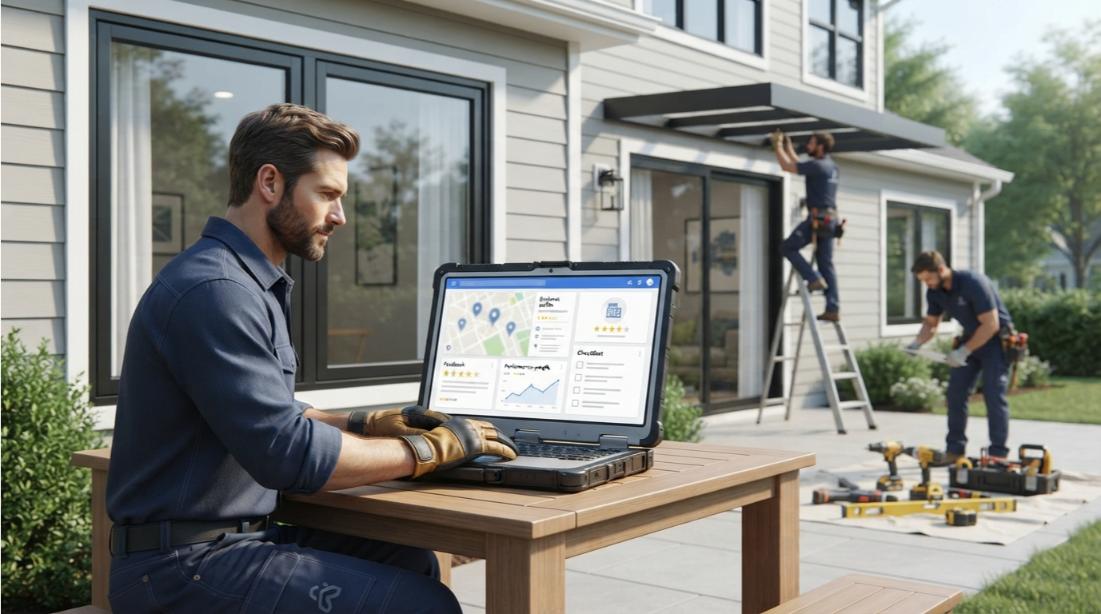


When homeowners need a contractor, they often search for what they need plus “near me.” These searches can signal that someone is ready to compare providers, request an estimate, or schedule a project. For home improvement companies, showing up in those moments can be valuable. The key isn’t stuffing “near me” into your website. It’s building strong local relevance through your Google Business Profile, website, reviews, service area, and overall online presence.
What Are “Near Me” Searches?
Near me searches are location-based searches where someone asks Google to find businesses, services, or products close to their current location. Examples include “home remodeling contractor near me,” “window replacement near me,” and “patio contractor near me.”
Google can use various signals to understand which businesses are relevant to the search. These can include the searcher’s location, the business’s information, the services offered, reviews, website content, and other local signals.
For a home improvement company, this makes Local SEO particularly important. A homeowner searching for a contractor isn’t necessarily looking for a national resource. They usually want someone who serves their area and can actually complete the work.
Why “Near Me” Searches Matter for Home Improvement Companies
Home improvement projects often involve significant spending and require customers to feel confident before making contact. A search such as “retractable screen installer near me” or “home renovation contractor near me” can indicate much stronger commercial intent than a general search about home renovations.
That is why the goal shouldn’t be to rank for every possible “near me” variation. The goal is to establish enough local relevance that Google can confidently connect your business with homeowners searching for the services you genuinely provide.
How Google Determines Which Businesses Appear for “Near Me” Searches
Local search isn’t based on one factor. Google considers multiple signals when determining which businesses are relevant to a particular local search.
Relevance
First, Google needs to understand what your business does. Your Google Business Profile, website, service pages, categories, and other online information should clearly communicate your services.
If you specialize in exterior shading, for example, your website should clearly explain the products and services you offer rather than relying on a vague description such as “full-service contractor.”
Distance
Distance also matters. Google may consider how close a business is to the person searching.
This is particularly important for a Service Area Business. A company may serve customers across multiple communities without maintaining a physical storefront in every one of them. Your service area should accurately reflect where you actually operate.
Prominence
Prominence relates to how established and well-known a business appears online. Reviews, mentions, links, citations, and the overall strength of your digital presence can contribute to that picture.
These factors can influence your visibility in Local Search Results, including the Local 3-Pack and Google Maps.
1. Optimize Your Google Business Profile
Your Google Business Profile is one of the most important foundations of local search visibility.
Start by making sure your business name, phone number, website, hours, categories, and other details are accurate. Select the most appropriate primary category for your company and add relevant services where applicable.
Your profile should also communicate the areas you serve. Add quality photographs of completed projects, team members, products, and other legitimate business activities.
For a home improvement company, photos can be especially useful because customers want to see evidence of the work before they make contact.
Avoid trying to manipulate your listing by creating fake locations or using addresses where you don’t actually operate. Build your local presence around genuine business information.
2. Strengthen Your Google Maps Presence
Google Maps is closely connected to local discovery. Homeowners may use it to compare nearby companies, read Google Reviews, look at project photos, visit a website, or call a business.
Check how your company appears on Maps and make sure the information matches your website and other listings.
If your company has changed its phone number, name, address, or operating hours, update the relevant platforms rather than allowing conflicting information to remain online.
3. Build a Strong Local SEO Foundation
A successful Local SEO strategy isn’t limited to your Google Business Profile. Your website and other online properties should reinforce the same geographic and service information.
Make your service area clear. Mention the communities you genuinely serve where it makes sense, and develop useful content around those locations.
This is where Service Area SEO becomes important. Rather than trying to rank everywhere, focus your resources on the markets where your company actually wants customers.
4. Target Location-Based and Geo-Modified Keywords
Keyword research for local businesses should reflect how real customers search.
Location-Based Keywords commonly combine a service with a geographic location, such as:
“window replacement in Orlando”
“home remodeling contractor in Tampa”
“patio installation in Austin”
Geo-Modified Keywords can also include variations such as a service followed by a city, neighborhood, or regional term.
Don’t force these phrases into every paragraph. Use them naturally in page titles, headings, service descriptions, and other relevant areas.
Your research should also identify high-intent keywords. Someone searching “how to choose replacement windows” has a different intent from someone searching “window replacement company near me.”
Both searches can be valuable, but they require different types of content.
5. Create Location-Specific Content
Location-Specific Content can help demonstrate that your company genuinely understands the areas it serves.
Instead of producing dozens of generic pages that only replace one city name with another, create useful local content. Discuss relevant services, completed projects, homeowner concerns, regional considerations, and the communities you actually serve.
For example, a remodeling company could create a useful page explaining the types of exterior renovation projects it completes in a particular service area, supported by real project examples.
This approach provides value to both potential customers and search engines.
6. Build Detailed Service Pages
Your website should have dedicated Service Pages for your most important offerings.
A service page should explain what you provide, who it’s for, what the process looks like, and why customers might choose your company. Include relevant project examples, FAQs, testimonials, and information about the areas where that service is available.
A dedicated page for each major service also gives search engines a clearer understanding of the relationship between your business and specific search terms.
7. Create Valuable Location Pages
Location Pages can be useful when your business serves multiple cities or communities.
However, don’t create pages simply because you want to add more city keywords. Each page should provide something useful about serving that particular location.
Include relevant services, local project examples, customer experiences, FAQs, and a clear way to contact your company.
These pages can function as Local Landing Pages for visitors who search for your service in a specific geographic area.
8. Generate More Google Reviews
Reviews are important for both customer trust and your overall local presence. Google Reviews give potential customers an opportunity to see what previous clients experienced.
Create a consistent process for requesting feedback from genuine customers after completed projects. Make the process simple, but don’t pressure customers to provide misleading feedback.
Respond to reviews professionally as well. A thoughtful response can demonstrate that your company pays attention to customer experience.
9. Keep Your NAP Information Consistent
Your NAP (Name, Address, Phone) information should be accurate across your online presence.
Check your website, Google Business Profile, directories, social profiles, and other business listings.
Inconsistent information can create confusion. For example, if an old phone number appears on an important directory while your website displays a different number, a prospective customer may not know which information to trust.
10. Build Relevant Local Citations and Listings
Local Citations are mentions of your business information on other websites. These can include directories, industry organizations, local associations, and other relevant platforms.
Focus on accurate, trustworthy Local Listings rather than trying to submit your business to every directory you can find.
Industry-specific and locally relevant listings can be especially useful because they provide context about your business and the market you serve.
11. Earn Local Backlinks
Local Backlinks can strengthen your website’s authority while reinforcing its connection to the communities you serve.
Potential opportunities include local publications, trade associations, suppliers, community organizations, partnerships, sponsorships, and relevant industry websites.
The goal isn’t to collect hundreds of links. A smaller number of relevant, credible links can be more meaningful than a large collection of unrelated links.
12. Make Your Website Mobile-Friendly
Many near me searches happen while people are away from their computers. That makes Mobile Optimization essential.
A homeowner should be able to open your website on a phone and quickly find your phone number, services, project photos, service areas, and estimate form.
Keep navigation simple, use readable text, make buttons easy to tap, and avoid unnecessary elements that slow down the mobile experience.
13. Add Relevant Schema Markup
Schema Markup gives search engines additional structured information about your website and business.
Depending on your site, relevant structured data may include LocalBusiness, Organization, Service, or Breadcrumb markup.
Make sure the information represented in your structured data accurately reflects the visible information on your website. Schema isn’t a substitute for strong content or local authority, but it can help search engines interpret your business information more clearly.
14. Focus on High-Intent Searches and Lead Generation
Ranking for a “near me” search is useful only if it connects with the right customer.
A person searching “home improvement ideas” may still be researching. Someone searching “home improvement company near me” or “get quote for window replacement” may be much closer to contacting a contractor.
This is where High-Intent Local Leads become the real objective.
Your website should make the next step obvious. Include clear calls to action, easy estimate forms, click-to-call options, project galleries, reviews, and concise service information.
Don’t make visitors hunt for a way to contact you after they’ve already demonstrated interest.
Common Mistakes That Prevent Home Improvement Companies From Ranking for “Near Me”
One common mistake is stuffing “near me” into page titles and website copy. Google doesn’t need to see the phrase repeated dozens of times to understand local intent.
Other problems include incomplete Google Business Profiles, inconsistent NAP information, fake locations, thin location pages, duplicate content, poor mobile experiences, neglected reviews, and irrelevant backlinks.
Another mistake is trying to target locations the company doesn’t genuinely serve. Local SEO works best when your online presence accurately reflects your real-world business.
“Near Me” SEO Checklist for Home Improvement Companies
Before considering your local strategy complete, make sure you’ve addressed the fundamentals:
- Google Business Profile is complete and accurate.
- Google Maps information is correct.
- Service areas are clearly defined.
- Location-based and local keywords have been researched.
- Important service pages are optimized.
- Valuable location pages are available where appropriate.
- Google Reviews are being generated and managed legitimately.
- NAP information is consistent.
- Local citations and listings have been audited.
- Relevant local backlinks are being earned.
- The website is optimized for mobile users.
- Appropriate Schema Markup is implemented.
- High-intent searches have dedicated conversion paths.
Frequently Asked Questions
How do I get my home improvement company to show up for “near me” searches?
Start with an accurate Google Business Profile, clearly defined service areas, strong service pages, consistent business information, genuine Google Reviews, relevant local content, citations, and a trustworthy website.
Does putting “near me” on my website improve rankings?
Simply repeating “near me” isn’t an effective strategy. Focus instead on establishing genuine local relevance through your business information, service areas, website content, reviews, and other local signals.
Can a Service Area Business rank for “near me” searches?
Yes. A legitimate Service Area Business can establish local relevance by accurately communicating the areas it serves and maintaining a strong local online presence.
Should I create a location page for every city I serve?
Only when you can provide useful, original information about serving that location. Avoid mass-producing nearly identical pages that offer little value to visitors.
How long does it take to rank for “near me” searches?
There is no fixed timeline. Competition, location, existing authority, website quality, reviews, content, and your current local presence can all affect how quickly visibility develops.
Final Thoughts
Ranking for “near me” searches isn’t about repeating a two-word phrase across your website. It’s about proving that your home improvement company is relevant to a specific service, trusted by real customers, and genuinely available in the area being searched. A strong Google Business Profile, useful local content, reviews, citations, service-area signals, mobile website, and local authority can turn local search visibility into high-intent leads.